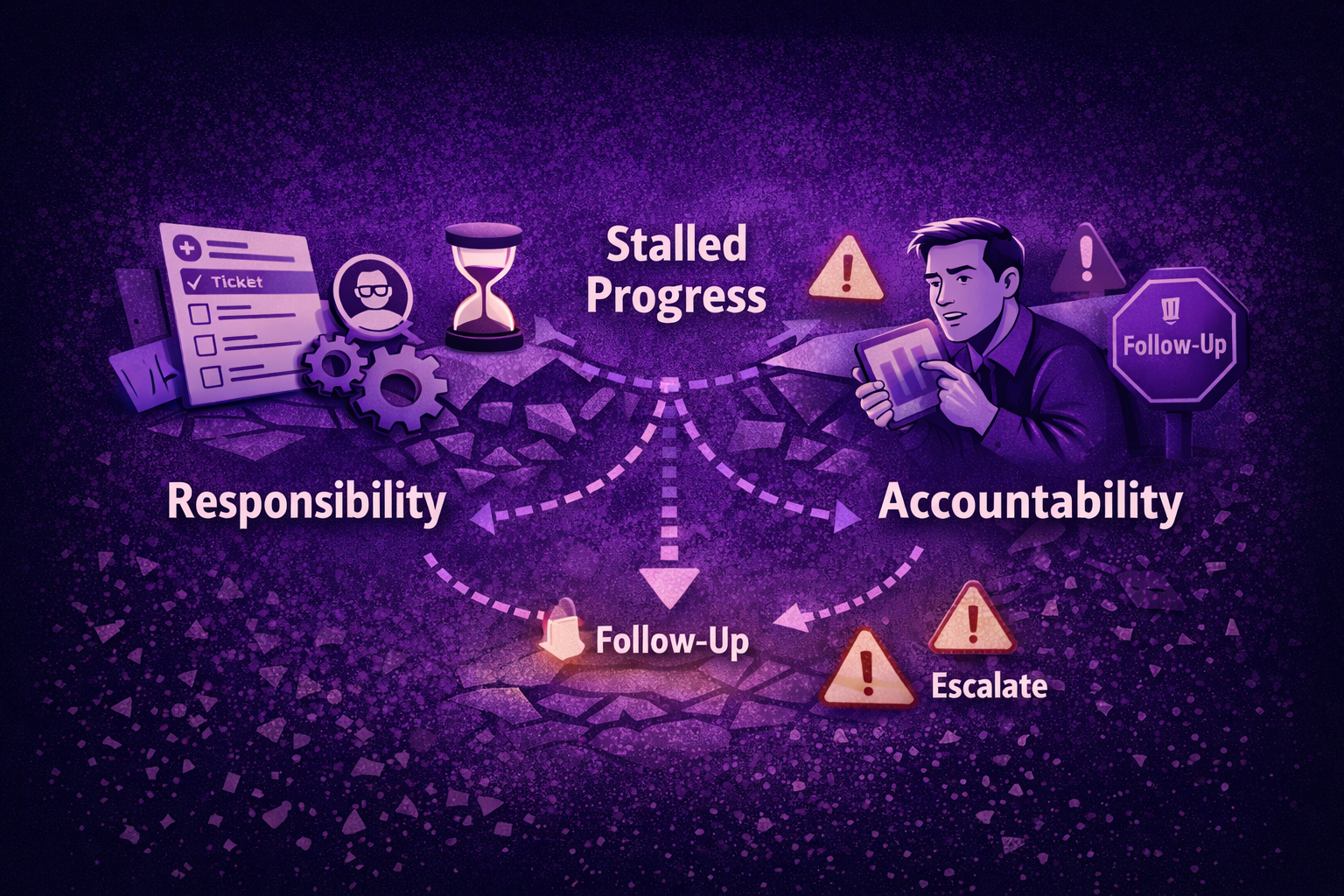
Most delivery failures aren’t caused by people avoiding work, but by confusing responsibility with accountability. Responsibility assigns tasks, while accountability owns the outcome and acts when work stalls, especially at handoffs and dependencies. Modern delivery tools track who is assigned work but rarely surface when progress breaks down, leaving leaders to manually reconstruct what happened. Teams that scale successfully build systems that detect stalled work early, trigger direct follow-up, and escalate issues before drift turns into missed delivery.
Every ticket in your backlog has someone responsible for it. An engineer's name is in the assignee field. A team owns the epic. A product manager approved the spec.
And yet work stalls. PRs sit unreviewed for days. Tickets idle in In Progress with no commits. Dependencies between teams go unresolved because both sides assumed the other would act first. When the sprint review arrives and delivery has slipped, nobody is surprised, but nobody saw it coming either.
The problem is not that people are not doing their jobs. It is that responsibility and accountability are being treated as the same thing, and in software delivery, they are not. This is a structural distinction, not a semantic one. And once you see how many delivery failures trace back to it, you cannot unsee it.
We have worked with enough teams to see the same confusion play out regardless of company size, industry, or methodology. Everyone uses these two words interchangeably. That conflation creates a specific, predictable failure mode.
Responsibility is who does the work. An engineer implements a feature. A reviewer approves a PR. A QA engineer runs the test suite. You can split responsibility across a dozen people on the same initiative and it works fine. Responsibility is a task assignment. Every team has it.
Accountability is who owns the outcome. One person. Not a group. One person who is expected to notice when the work stalls, act on it, and answer for the result. Accountability cannot be shared without becoming meaningless. The moment you make three people jointly accountable for a deliverable, you have made zero people accountable.
Every delivery tool in your stack is built around responsibility. Almost nothing in that stack enforces accountability.
Jira assigns tasks. GitHub assigns reviewers. Sprint planning allocates work. These are all responsibility mechanisms. But almost nothing in that stack enforces accountability: someone watching whether the work is actually progressing and acting when it is not. We have set up delivery infrastructure for teams ranging from five-person startups to 50-engineer distributed organizations, and this gap is nearly universal. The tools track who is supposed to do what. Nothing tracks whether it is actually happening.
The gap between assigning work and ensuring it moves is where most delivery failures live.
Consider a feature that requires work from two squads. Squad A builds the API. Squad B builds the frontend that consumes it. Both squads have their tickets. Both have engineers assigned. Responsibility is clear.
But who is accountable for the integration? Who is watching whether Squad A's API landed on time and whether Squad B picked it up? Who notices when the handoff stalls because Squad A's PR is sitting in review and Squad B's sprint started without the dependency being resolved?
In most teams, the honest answer is the engineering manager or the PM, and the mechanism is they will notice in the next standup. That is not accountability. That is hope dressed up as process. Real accountability means someone is specifically designated to own the outcome of that handoff, with the authority and the information to act when it stalls. Not 24 hours later in a meeting. When it happens.
The individual tasks are owned. The spaces between tasks are not. Handoffs, dependencies, review queues, cross-team coordination: these are the delivery seams, and they are precisely the places where accountability is absent.
The Tricentis Quality Transformation Report, a 2025 survey of over 2,700 software delivery practitioners worldwide, found that 33 percent of teams cite poor communication between development and QA as their single biggest quality hurdle, and 63 percent of organizations ship code without completing all necessary testing. Those numbers do not describe a skills problem or a tooling problem. They describe an accountability problem. The seams between teams, between stages of delivery, between my part is done and the whole thing shipped, are the places where nobody is watching.
The PMI Pulse of the Profession 2025, a survey of nearly 3,000 project professionals worldwide, found that only about half of all projects are considered successes. Twelve percent are outright failures. Forty percent produce mixed results. PMI's own framing is telling: the differentiator is not better tools or more process. It is whether the people leading projects connect execution to outcomes and act on risk before it hardens.
We have watched engineering leaders spend their first two hours every morning doing exactly this: opening Jira, cross-referencing GitHub, checking Slack threads, trying to reconstruct what happened overnight across three time zones. That is not leadership. That is manual coordination wearing a leadership hat.
If you have worked in any structured organization, you have encountered a RACI matrix. Responsible, Accountable, Consulted, Informed. The theory is sound. Designate one person as accountable for each deliverable, and confusion disappears.
In practice, RACI charts are created at the start of a project, stored in a Confluence page, and never referenced again. We have seen this across dozens of teams. The chart gets built, approved, and then ignored because the work environment moves faster than the document.
RACI defines accountability as a static role assignment, but accountability in delivery is not static. It is dynamic. The person accountable for a deliverable needs real-time information about whether the work is on track, and they need a mechanism to act when it is not. A RACI chart that says Jane is accountable for the payment integration is useless if Jane has no way to know that the payment service PR has been waiting for review for three days, that the dependency from the billing team has not been resolved, or that the QA environment is broken and nobody has flagged it.
Static accountability without dynamic signals is just another document that describes an ideal state nobody is living in. The failure is not in the RACI model itself. The failure is in assuming that naming someone accountable gives them the information and the mechanisms to actually exercise that accountability.
The teams we have seen make accountability work do not start with a chart. They start with three operational questions: what are the signals that tell us work is stalling, who specifically needs to know when those signals fire, and what is the expected response time and escalation path. Those three questions, answered honestly and enforced consistently, create more accountability than any governance framework.
One area where software teams have made meaningful progress on accountability is code ownership, specifically through mechanisms like CODEOWNERS files that map specific files and directories to the individuals or teams responsible for reviewing changes. When a PR touches a file, the system automatically requests a review from the designated owner. Combined with branch protection rules that require code owner approval before merging, this creates an enforceable accountability mechanism. Changes to critical code cannot land without the right person reviewing them.
This is worth studying because it reveals what makes accountability real rather than aspirational. It works because it is automated, specific, and tied to a real workflow. Nobody has to remember to request a review. Nobody has to check a document. The system enforces the accountability rule every time a PR is opened. There is no gap between the policy and the enforcement.
But code ownership only covers one slice of the delivery process: the review step. It does not address whether the work leading up to that PR is progressing. It does not flag that a ticket has been assigned but untouched for four days. It does not notice that the owner of a blocked ticket is on PTO and nobody has reassigned it. Code ownership solves accountability for code review. Delivery accountability is a much broader problem, and the fact that teams have solved it for one step makes it more striking that the rest of the delivery lifecycle has no equivalent mechanism.
We spent a long time thinking about accountability as a framework problem before we realized it is an infrastructure problem. You do not need a new governance model. You need to connect three things that most teams already have but never link together.
The first is ownership signals: the data that tells you whether work is progressing. Commits against a ticket. PR activity. Review status. Deployment events. These signals already exist in your tools. The question is whether anyone is watching them as a connected system or whether they are sitting in separate dashboards that nobody checks until something goes wrong.
The second is follow-up loops: the mechanism that turns a signal into action. When a ticket has been in In Progress for 48 hours with no commits, who gets notified? When a PR has been waiting for review past your team's threshold, does the reviewer get a direct message, or does it wait for someone to mention it in standup? Follow-up needs to be directed. It goes to a specific person with a specific expected action, not broadcast to a channel where everyone assumes someone else will handle it. A message in a shared Slack channel is not a follow-up. It is a hope that someone in the right time zone will read it before the next business day.
The third is escalation paths: if a follow-up does not resolve the issue within a defined window, someone with authority needs to know before the next weekly sync. Escalation rules need to be defined in advance, agreed upon by the team, and enforced consistently. The goal is not pressure or blame. It is ensuring that stalled work does not remain invisible long enough to become a delivery risk.
You can build these three components manually. Define what signals matter, assign follow-up owners for each signal, and create escalation rules with explicit time windows. Run it for a sprint and see what surfaces. The first sprint always reveals two things: the accountability gaps you already suspected, and several you did not know existed. The most common surprise is how much work stalls at handoff points. The second most common surprise is how long those stalls have been happening without anyone noticing.
There is an important distinction between wanting accountability and having it. Many teams talk about accountability in retrospectives. Few have systems that create it.
Culture matters. Teams where engineers feel ownership over outcomes, not just tasks, ship more reliably. Teams where people feel comfortable raising blockers early create fewer late-stage surprises. But culture alone does not scale. A team of eight engineers can maintain informal accountability because everyone sees everyone else's work. The standup is short enough to actually surface information. The PM knows every engineer personally and can read the subtle signals that someone is stuck but has not said so.
A team of 40 engineers across three time zones cannot sustain any of that. At that scale, accountability either lives in systems or it does not exist. This is one of the hardest transitions growing engineering organizations face, and the ones that navigate it well tend to formalize accountability mechanisms before the informal ones break, not after. By the time a leader realizes they have been the accountability system all along, they are already drowning in follow-up.
The failure mode we see most often is leaders who assume that clear ownership means accountability exists. It does not. Ownership means someone is assigned. Accountability means someone is watching, following up, and answering for the result. The first is a Jira field. The second is a delivery system. And the gap between them is where delivery quietly drifts until someone asks why we are behind in a sprint review.
One important caveat: accountability systems should reinforce good habits, not manufacture blame. The goal is to surface stalled work early so it can be resolved, not to create a surveillance culture where engineers feel monitored. The best accountability frameworks we have seen are transparent about what is being tracked and why, and they focus on work progress rather than individual performance. When engineers understand that the system exists to catch stalls before they become delivery risks, adoption is straightforward. When it feels like surveillance, people game the signals rather than resolving the underlying issues.
The real challenge is sustaining this. You can run signal monitoring, follow-up, and escalation manually for a sprint or two. But manual accountability degrades the moment that person goes on vacation, switches teams, or gets pulled into a planning cycle. The signals are still firing in Jira, GitHub, and Slack. Nobody is reading them as a connected system. At that point, the accountability layer does not just have gaps. It does not exist.
DevHawk monitors those execution signals across your delivery stack in real time. When a ticket sits in In Progress with no commits for 48 hours, when PRs age past review thresholds, when work stalls across a handoff between time zones, it identifies the stall and triggers a follow-up to the right owner in Slack. If it still does not move, it escalates based on rules your team defines.
This is not a replacement for clear ownership or good culture. It is the connective tissue that links them to action. The engineer who owns a ticket still owns it. The team lead who is accountable for the sprint still is. DevHawk ensures that when work drifts, the right person knows about it before a standup surfaces it 24 hours too late.
DevHawk works best when ownership is already clear. If tickets do not have real owners, or if done means different things across the team, automation amplifies confusion rather than resolving it. Tools do not fix culture, but they can reinforce the habits that make a team reliable. The goal is not more visibility. It is less waiting.
What is the difference between accountability and responsibility in software teams? Responsibility is about who does the work. Accountability is about who owns the outcome and is expected to act when the work stalls. Multiple people can share responsibility. Accountability needs to be singular to be meaningful.
How do you create accountability in distributed teams without micromanaging? Build systems that surface signals automatically rather than requiring manual check-ins. When the system tells the right person that work has stalled, you do not need to chase updates. The accountability comes from the signal and the follow-up loop, not from the manager asking questions.
Why do RACI charts and governance frameworks not fix accountability problems? RACI charts define who should be accountable but do not provide the real-time signals or follow-up mechanisms needed to exercise that accountability. Static documents do not match the dynamic pace of delivery. Effective accountability requires connecting ownership signals, directed follow-up, and escalation paths to actual workflows.
Related: async standups, delivery metrics that matter, blocker detection for distributed teams, engineering team structure at scale, coordination tax, PR review bottlenecks
Sources cited:
PMI, "Pulse of the Profession 2025: Boosting Business Acumen". Survey of ~3,000 project professionals worldwide.
Tricentis, "2025 Quality Transformation Report". Survey of 2,750 software delivery practitioners across 10 countries.
