There are over 200 companies providing engineering intelligence tools - tools that analyze developer performance metrics in detail. The critical challenge? None of these tools actually Do any work - they provide great analytics, but they don't communicate with at-risk developers, they don't assign tasks, and they don't set up meetings. Diving deeper into a real life scenario highlights the difference.
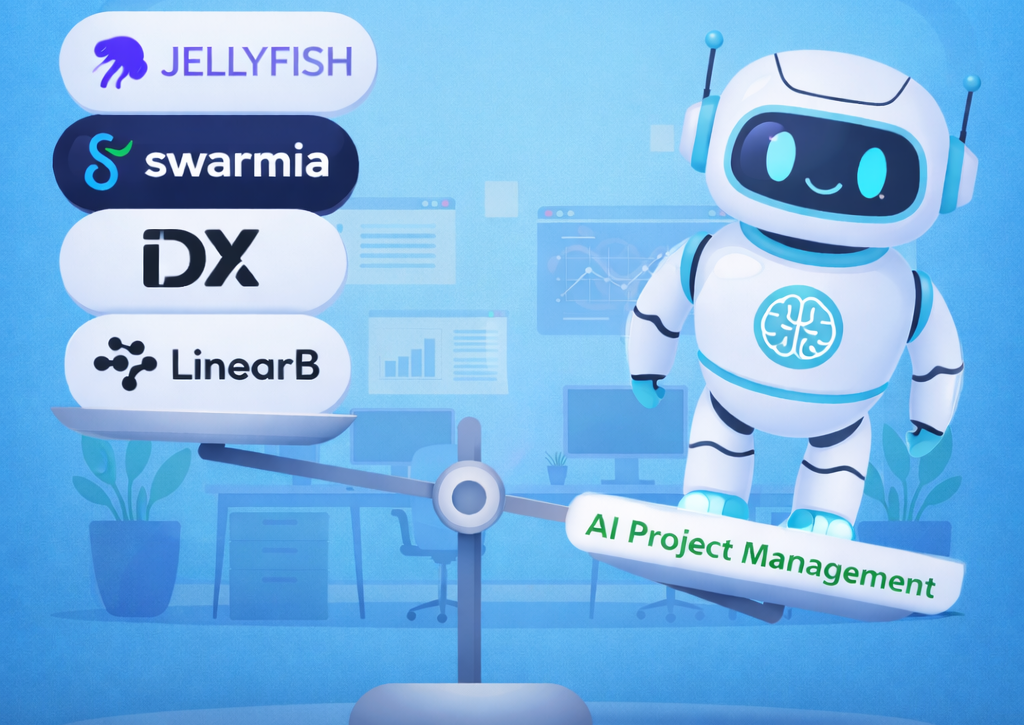
The term "AI PM" is starting to appear in marketing materials everywhere. But when you look under the hood, most solutions aren't actually doing product and project management work - they're doing analytics and reporting.
The most sophisticated tools in this space - engineering intelligence platforms like Jellyfish, Swarmia, LinearB, and GetDX - represent the state of the art in understanding engineering team productivity. They've invested heavily in aggregating data, building metrics frameworks, and surfacing insights.
But there's a fundamental gap between what they provide and what engineering teams actually need.
Jellyfish positions itself as "engineering management platform" focused on helping engineering leaders align engineering work with business priorities. They emphasize investment allocation - understanding where engineering time is actually going.
Swarmia focuses on "developer experience" and productivity metrics, with strong emphasis on DORA metrics and helping teams identify bottlenecks in their delivery pipeline.
LinearB targets "software delivery intelligence," offering workflow automation alongside their metrics. They've pushed into gitStream for automating PR routing and labeling.
GetDX takes a developer experience research approach, combining quantitative metrics with qualitative surveys to understand what's actually slowing teams down.
Other players include Haystack, Pluralsight Flow (formerly GitPrime), Code Climate Velocity, Sleuth, Faros AI, WorkWeave, and more. Each has slightly different positioning, but they share a common DNA.
"Data-driven insights into your engineering team's productivity and performance."
"Understand where engineering investment is going."
"Identify bottlenecks before they impact delivery."
"Benchmark against industry standards."
These aren't empty promises and these platforms do genuinely deliver on visibility. The question is whether visibility alone is enough.
At their core, these platforms are sophisticated dashboards that aggregate data from your development tools and present metrics.
They connect to your GitHub/GitLab, Jira/Linear, Slack/Teams, and calendar systems. They pull data, compute metrics, and display charts.
DORA Metrics have become the industry standard for measuring software delivery performance. These platforms track deployment frequency (how often you ship), lead time for changes (how long from commit to production), change failure rate (how often deployments cause problems), and mean time to restore (how quickly you recover from failures).
Developer Productivity Metrics go deeper into the development workflow: cycle time from idea to production, PR review time and review depth, code churn and rework rates, work in progress limits and flow efficiency.
Team Health Indicators attempt to capture the human side: meeting load and focus time availability, after-hours work patterns, collaboration networks and knowledge silos, developer satisfaction (via surveys in platforms like GetDX).
Investment Allocation (emphasized by Jellyfish) categorizes where engineering time goes: new features vs. maintenance vs. technical debt vs. support. This helps leaders answer "what are we actually spending engineering time on?"
Let's give credit where it's due. These platforms solve real problems.
Visibility into patterns: Before these tools, understanding team performance meant manually pulling data from multiple systems, building spreadsheets, and hoping your analysis was accurate. These platforms surface trends you're unlikely to notice manually, like the fact that PR review time has crept up 40% over six months, or that one team ships faster than others despite working on bigger features.
Benchmarking: Is your 18-hour average PR review time good or bad? Without context, you can't know. These platforms provide industry benchmarks so you can compare your team's performance to similar organizations.
Root cause analysis: When delivery slows down, these tools help you understand why. Is it code review bottlenecks? Too many meetings? Unclear requirements? Work distribution imbalance? The data tells the story.
Leadership reporting: Engineering leaders need to communicate with executives who don't understand git commits. These platforms provide executive-friendly dashboards that translate engineering work into business terms.
Data-driven conversations: "I feel like we're slow" becomes "our cycle time is 40% higher than industry benchmark, primarily driven by PR review delays." This transforms subjective debates into objective discussions.
Here's the fundamental problem with every engineering intelligence platform on the market: they show you the problem, but they don't fix it.
Imagine your Jellyfish or Swarmia dashboard shows the following situation: Tom has 7 pending code reviews with an average age of 3.2 days. Mike is over his WIP limit with 5 tasks in progress. PR review time has spiked 35% in the past two weeks. The payment integration task is at 2x expected duration with no commits in 48 hours.
This is valuable information. But what happens next?
The dashboard doesn't message Tom asking him to prioritize those reviews. It doesn't suggest to Mike that a task should be reassigned. It doesn't automatically rebalance work when someone finishes early. It doesn't follow up when the payment integration task remains stuck. It doesn't investigate why Tom has a review backlog—is he overloaded? Out sick? Stuck on a complex review?
The platform observes. It measures. It reports. It does not act.
Engineering intelligence platforms are brilliant thermometers. But they're not thermostats.
When you deploy an engineering intelligence platform, you still need a human to:
Look at the dashboard. How often? Daily? Weekly? When you remember? Most teams check sporadically. Problems fester between check-ins.
Interpret the metrics. Is 18-hour PR review time bad for your team? It depends on context: review complexity, team norms, timezone distribution. The dashboard shows data and might even make a recommendation, but a human must actually do something about it.
Decide what to do. The dashboard shows Tom has a review backlog. Should you message him directly? Talk to his manager? Reassign reviews to others? Wait and see? This requires judgment.
Take action. Someone has to actually send that Slack message, have that conversation, update that Jira ticket. The dashboard doesn't do this.
Follow up. Did things improve? You'll have to check the dashboard again next week to find out. No one proactively tells you whether your intervention worked.
They've automated the measurement. Not the management.
Many engineering intelligence platforms are now adding "AI" to their marketing. Jellyfish offers AI-generated summaries. LinearB has AI-powered recommendations. GetDX uses AI to analyze survey responses.
A typical "AI insight" might look like this: "Your team's PR review time has increased 35% in the past 2 weeks. Primary cause: Tom (Tech Lead) has 7 pending reviews with average age of 3.2 days. Recommendation: Consider designating a backup reviewer or redistributing review load."
This is genuinely useful! The AI correctly identified the root cause and suggested a reasonable solution.
But it's still just an insight. A recommendation. A notification sitting in a dashboard.
The AI doesn't message Tom asking if he needs help. It doesn't identify which specific PRs could be delegated. It doesn't auto-assign backup reviewers. It doesn't check back in 24 hours to see if the situation improved. It doesn't learn that Tom always gets backlogged during the last week of the quarter.
You still have to read the insight, decide if you agree with the analysis, figure out how to act on it, actually do the coordination work, and monitor whether it helped.
An insight is not an action.
This is the difference between a fitness tracker telling you "You should exercise more" and a personal trainer who schedules your workouts, checks if you showed up, adjusts your routine based on progress, and holds you accountable. Both involve "intelligence." Only one creates results.
Let's walk through a concrete example to see the difference between intelligence and action.
The situation: Mike has been working on "Payment gateway integration" for 4 days. It's a 3-point story (normally 1.5 days for this team). He hasn't committed code in 48 hours. The task is blocking the entire sprint.
Your Swarmia, Jellyfish, or LinearB dashboard shows: TASK-445 has been in progress for 4 days (team average: 1.5 days). No commits in 48 hours from Mike. This task is flagged as a potential bottleneck.
What happens next? Nothing until someone checks the dashboard.
Maybe the engineering manager checks on Monday morning. Maybe the PM notices during Wednesday's standup prep. Maybe no one looks until the sprint review when everyone realizes the payment feature isn't done.
When someone finally notices, they message Mike: "Hey, how's the payment integration going?" Mike responds: "Oh, I've been stuck waiting for API credentials from DevOps. Asked about it in Slack three days ago but never heard back."
Three days of blocked work. The dashboard showed the symptom (task running long). It didn't diagnose the cause (external blocker). It didn't take action (escalate to DevOps). It didn't prevent the delay.
The platform observed the problem. A human had to solve it.
An AI PM doesn't wait for someone to check a dashboard. It monitors continuously and acts when needed.
Hour 48 (Thursday 2 PM): The AI PM detects no commits in 48 hours—unusual for Mike, who normally commits daily. It analyzes that the task is at 2x expected duration. It checks Mike's Slack history and finds he asked about API credentials two days ago with no response.
AI reasoning: "High probability Mike is blocked waiting for API keys. This isn't normal task complexity—this is an external blocker that's been unaddressed for two days."
Action 1: Private Slack to Mike: "Hey Mike! I noticed the payment integration might be stuck—still waiting on those API credentials you asked about? I can escalate to DevOps if that would help."
Hour 50 (Mike confirms he's blocked):
Action 2: Message to DevOps: "Hi team. Mike is blocked on TASK-445 (payment gateway integration) waiting for production API credentials. This is blocking our sprint. Can someone help provision these today?"
Simultaneously, the AI PM updates the project manager: "FYI escalated Mike's blocker to DevOps. He's been stuck 2 days waiting for API credentials. I've asked DevOps to prioritize."
Hour 54 (DevOps provides credentials):
Action 3: Message to Mike: "Great news DevOps just provided the API credentials in #infrastructure. You should be unblocked now. Let me know if you need anything else!"
Update to PM: "Blocker resolved. Mike is back in action on TASK-445. Based on remaining scope, should be complete by EOD tomorrow."
Result: Problem detected in real-time, context gathered automatically, appropriate parties engaged, blocker resolved in 6 hours instead of days.
Engineering intelligence: Shows you yesterday's problems when you check the dashboard.
AI project management: Detects, diagnoses, and resolves problems autonomously in real-time.
Here's what no engineering intelligence platform provides today:
Continuous, intelligent monitoring.
Autonomous decision-making.
Context-aware communication.
Adaptation and Escalation.
This is the missing category: The Proactive AI Project Manager.
If autonomous project coordination is so valuable, why haven't engineering intelligence vendors built it? Three reasons:
1. Technical feasibility. Until LLMs became reliable (roughly 2023+), it wasn't clear this was even possible. Can AI reliably parse meeting transcripts and extract action items? Can it understand project context well enough to make reasonable decisions? Will developers accept AI-initiated messages, or will they find them annoying? How do you handle edge cases and errors gracefully? Analytics dashboards are a proven product category with clear buyer expectations. AI project management is new territory with no established playbook.
2. Market positioning. Engineering intelligence vendors have built their businesses around selling to engineering leadership—VPs and Directors who want visibility into their organizations. "Better dashboards for engineering leaders" is an easy pitch. "Let AI coordinate your team's work" requires more trust, more explanation, and more change management. It's a different buyer, a different sales motion, and a different risk profile.
3. Fear. The incumbents have gotten really good at analytics, but the next step, the Doing Step, is frankly scary! If your AI makes one wrong move, how much trust do you lose with existing clients? And can you reliably create AI that can navigate the politics of your enterprise customers?
But the technology is finally ready. And the need is enormous.
Engineering intelligence platforms have proven that teams want help with coordination. The data they surface—bottlenecks, blockers, capacity imbalances—represents real problems that cost real money. They just stop one step short of actually solving those problems.
The question now is: who will build the coordination layer that turns insights into action?
That’s our goal at DevHawk.ai!
In the next section, we'll dive deeper into the range of use cases DevHawk is solving across the software development life cycle.
How is an AI PM different from engineering intelligence tools?
Engineering intelligence tools observe and report delivery patterns, while an AI PM acts on those signals by initiating follow-ups, resolving stalls, and escalating issues in real time.
Does an AI PM replace product or project managers?
No. An AI PM removes repetitive coordination work so PMs can focus on judgment, prioritization, and strategic decision-making.
When does an AI PM provide the most value?
In distributed or fast-moving teams where work often stalls quietly between handoffs and manual coordination no longer scales.
