Traditional project management tools are fundamentally reactive, not proactive. As a result they've failed to solve a wide range of software team pain points, including context switching, estimation, communication, and more. Let's dive into the details on the pain points, why the status quo isn't working, and what is missing from the capabilities that exist today.
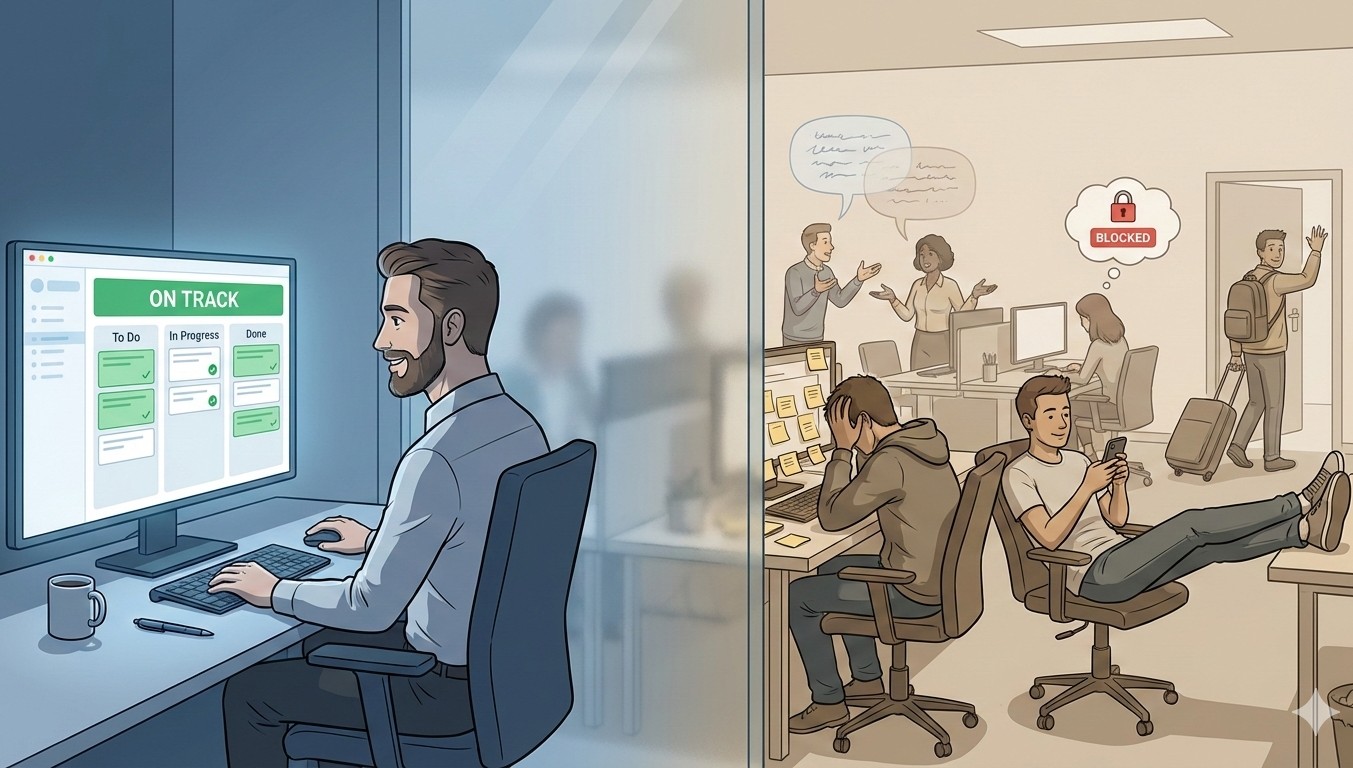
Despite dashboards, integrations, and a small fortune in software, coordination overhead still eats up a substantial percentage of time for most teams. The tools got better, but they just chipped away at the pain points - not a real solution.
This isn’t about buggy software or missing features. It’s about a deeper, structural flaw: traditional project management is reactive, human-coordinated, and increasingly brittle at scale.
You can’t dashboard your way out. You can’t integrate your way out. You can’t “just communicate better” your way out. Teams have tried more meetings, cancelling all their meetings and doing asyncs, and every variation in-between, but the coordination tax remains.
I’ve seen this tax up close at both early-stage startups and inside scaled orgs with 100M+ revenue. The burden doesn’t shrink - it actually compounds with headcount, with the square of headcount actually!
Here are five major pain points that plague every software team, regardless of which tools, meeting structure, and project management approach they use:
Research from the University of California, Irvine found that it takes an average of 23 minutes and 15 seconds to fully return to a task after an interruption. This is particularly impactful with knowledge work, and even impacts developers overseeing coding agents, as it takes time to get back in-context once disturbed.
Now consider the average developer's day:
1. Daily standup: 1 interruption
2. "Quick question" Slack messages: 7 to 10 interruptions
3. Code review requests: 2 to 3 interruptions
4. PM asking for status updates: 2 to 4 interruptions
5. Meetings and unplanned discussions: 2 to 5 interruptions
That’s 14 to 23 interruptions every single day.
Even if each only takes 5 minutes, the cognitive cost is catastrophic. If we assume half of those cause full context switches, that’s:
7 context switches x 23 minutes = 2.7 hours of lost productivity per day!?
Your developers aren’t spending 8 hours heads-down coding. They’re spending a good chunk of their day recovering from interruptions and trying to get back on track.
Why Existing PM Tools Don't Fix This:
Most traditional PM tools create *more* interruptions, not fewer. Jira pings for every comment, status change, and mention. Slack lights up every time someone @ mentions you AND anytime messages are sent in your watched channels. GitHub pings for review requests and its own comment threads - duplicating some of what’s happening in Jira, which is also duplicated by what’s happening in Slack. Calendar invites stack up for syncs that could be async.
These tools are designed to keep everyone "in the loop," but in practice, that means everyone’s constantly interrupted.
What’s missing: Intelligent coordination that batches updates, handles follow-ups asynchronously, and only interrupts humans when genuinely necessary. A system that knows the difference between something urgent - like Mike not committing code in 3 days - versus something informational, such as a task simply moving from "In Progress" to "Code Review."
Software estimation isn’t just hard - it’s a time sink. A typical story pointing session for a two-week sprint consumes:
1. 2 to 3 hours of prep for PMs writing up stories
2. 1 to 2 hours of team discussion in refinement
3. An hour of follow-up for clarifications
4. 30 to 60 minutes for re-estimation when scope inevitably shifts
Altogether, that’s 5 to 7 hours of collective effort - a huge chunk of the entire sprint.
And after all that? Teams are still wrong 40 to 60 percent of the time.
A 3-point story becomes a 13-point epic. A 5-point feature ships in a day.
The situation is bad enough that many teams skip the step entirely to save the effort - but then they deprive the team of a way to compare sprints and velocity on an apples-to-apples basis.
Why Existing PM Tools Don't Fix This:
Jira, Linear, Shortcut - they give you a dropdown for story points, maybe a velocity chart, or a planning poker plugin. But none of them actually help you estimate. They just digitize the process of humans guessing.
I’ve been part of these planning sessions at companies large and small - and it’s been guesswork at all of them. The actual cognitive load required to come up with a realistic estimate? Read the requirements, understand the technical scope, consider edge cases, and essentially architect a high-level solution! Since that can’t happen in the time available at the beginning of a sprint, people put fancy labels and rituals around the process of guessing.
What’s missing: A system that’s learned from millions of past tasks, knows your codebase and architectural approaches, and says:
"This is probably a 5-pointer. Here’s why."
There’s almost always critical information about project status exists only in someone’s head:
* Sarah is blocked but hasn't updated Jira (she will at standup tomorrow)
* Mike finished his task two hours ago but hasn't moved the ticket (he'll do it before EOD).
* Emma is stuck on acceptance criteria but hasn't asked (doesn't want to look incompetent).
* Tom mentally approved a PR but forgot to click "Approve", and won’t remember til he’s asked at the next meeting.
* The QA environment is broken, but the developer who last deployed there is embarrassed to reach out to DevOps for help resolving the problem.
This information asymmetry creates a fundamental coordination problem where the board shows one reality, but actual status is very different. Good project managers can be effective by spending much of their day chasing and eliminating these information silos and time gaps - but only by throwing manual effort at the problem.
Why PM Tools Don't Fix This:
PM tools are passive. They only show what humans manually update. You can add more required fields, you can automate reminder messages, and you can create "update your status" policies.
But you can’t force real-time synchronization between someone’s brain and your dashboard.
What’s missing: A system that monitors signals beyond manual ticket updates. It would look at GitHub commits - or the absence of them. It would learn from Slack conversation patterns and cross-reference that with calendar availability. It would monitor build and test results, as well as how long each ticket has been stuck in a given status.
Then, when it sees something off, it would proactively step in: "Hey Sarah, you've been on this task for 3 days with no commits. Everything okay?"
Critical context is discussed verbally, then disappears.
Take a typical standup:
Emma: "I'm working on the payment integration, should be done today."
PM: "Great. Mike, you needed those API endpoints - Emma, can you share those with Mike when you're done?"
Emma: "Oh yeah, sure."
Fast forward 3 days:
Mike posts in Slack: "Still waiting on those payment API endpoints..."
Emma: "Oh crap, I totally forgot. Let me get those to you."
The information existed. Everyone heard it. But it never made it into Jira, Slack, email, or any persistent system.
This happens constantly: decisions made in meetings that don’t get documented, blockers mentioned out loud that don’t get ticketed, dependencies identified that don’t get tracked, and commitments made in passing that never get followed up.
Why PM Tools Don’t Fix This:
Even the best note-taking practice fails because someone has to take the notes, usually the PM, while also running the meeting. Then they have to turn those notes into tasks, assign owners, and follow up later. It’s all coordination overhead.
Most teams are using AI meeting recorders these days - who hasn’t been on a recent meeting where more recorders show up than humans? But the resulting transcripts are often left disconnected from any system - so now there’s a wall of text that nobody reads and is never referenced.
What’s missing: A system that turns meetings into action. It should extract verbal commitments, create task tickets with context, assign them intelligently based on skill and availability, and most critically, follow up when deadlines are missed.
"Hey Emma, in Monday's standup you said you'd share the API endpoints with Mike by EOD. I don't see a ticket or Slack message. Should I create one, or did you handle this another way?"
Quick: Is your senior developer Sarah overloaded or underutilized right now?
If you're a PM, you probably open Jira, filter to "Assigned to Sarah," see three tickets in progress, and think "looks busy, probably fine."
But you don't actually know whether those three tickets are two-point quick wins or thirteen-point monsters. You don't know if one got blocked yesterday and she's waiting on someone else, or if she finished two other tickets this morning but hasn't updated the board yet. You have no visibility into whether she's about to go on vacation for a week, or whether she's spending half her time helping junior devs in ways that aren't tracked anywhere.
The result is constant capacity mismatch.
Sarah might actually be idle for four hours because she finished her work early, but you don't notice until she mentions it at tomorrow's standup. Or she's drowning with sixty hours of work assigned while Mike has twenty, but the ticket count looks similar—Sarah has three tickets, Mike has four. Or you assign Sarah a new ticket not knowing she has a dental appointment tomorrow and vacation next week.
Why PM Tools Don’t Fix This:
Modern PM tools give you:
* Sprint burndown charts (lagging indicator - tells you you're behind when it's too late)
* Velocity tracking (tells you past performance, not current capacity)
* Assignee filters (shows quantity of tickets, not actual workload)
* Calendar integrations (shows scheduled time off, not ad-hoc blockers)
But they don't give you real-time capacity intelligence:
* Who's actually available right now?
* Who's blocked and effectively idle?
* Who's overloaded and needs help?
* Who has upcoming time off that affects assignments?
* Who's context-switching too much between tickets?
What’s missing: A system that dynamically tracks workload based on current and historical data. One that looks at points assigned versus completed, active versus blocked tasks, time-in-status, team velocity, upcoming calendar constraints, and mentoring or review activity, then suggests smart adjustments.
"Sarah just finished her work and has 6 hours open today. Mike is blocked. Should I route a task to her or suggest she jump in to help?"
Looking across all five pain points, traditional PM tools are fundamentally reactive. They show you problems after they happen and rely on manual updates. They wait for humans to check dashboards and assume humans will follow up.
As a result, these tools don’t really reduce coordination overhead - they just give us prettier dashboards to watch it happen in real time. Knowledge is helpful, but when a team is capacity constrained, knowing about coordination issues isn’t enough to solve the problem.
A proactive system could fix this. We need systems that detect issues as they emerge, that monitor multiple sources for coordination signals, and that take action automatically on routine blockers. The ideal system only escalates to humans when judgment or nuance is truly required.
This isn’t about building a better Jira, or faster dashboards, or more integrations.
It’s about automating the coordination work itself.
And that requires actual intelligence - not just software, but reasoning.
Why do teams keep adding process instead of removing coordination overhead?
Because coordination failures are hard to attribute to a single cause. Process feels safer than changing how work is detected, escalated, and resolved at a system level.
Why does coordination work default to senior people over time?
As teams scale, ambiguity accumulates at handoffs and edge cases. Senior PMs and leads absorb this work because they have the context and authority, even though it’s the most expensive place for coordination to live.
What makes coordination a systems problem rather than a people problem?
The same failure patterns appear across different teams, tools, and individuals. When problems are consistent regardless of who’s involved, the constraint is structural, not behavioral.
