AI code review tools are getting smarter, but they may be solving the wrong problem. Most delivery failures aren't caused by bugs slipping through review. they're caused by PRs sitting idle in a queue for days while sprint commitments quietly slip. This piece breaks down why teams keep investing in automated review without seeing better delivery outcomes, and what the tooling stack actually needs to look like.
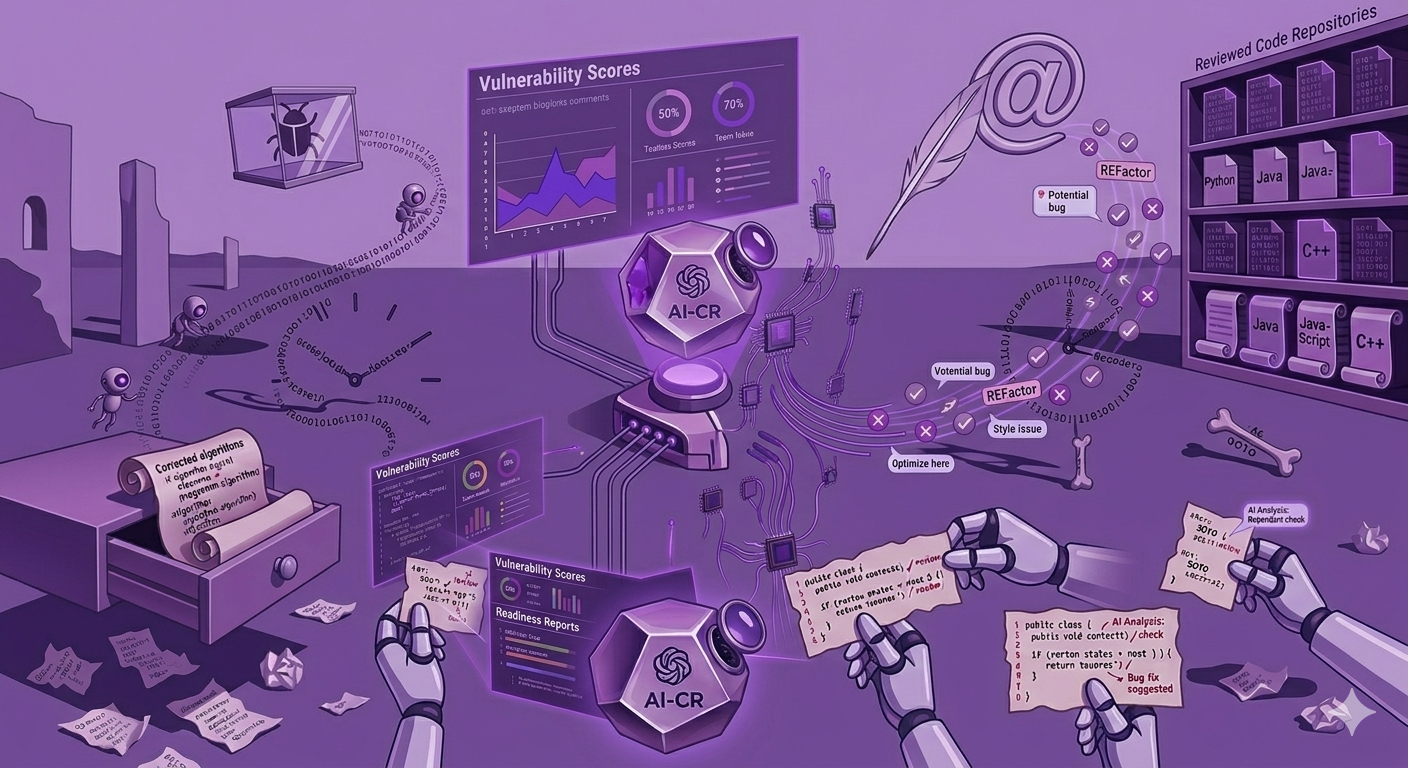
The conversation about AI code review tools usually starts in the wrong place.
Most of the content on this topic asks: what can AI catch that humans miss? That is a useful question for engineers. It is the wrong question for anyone accountable for whether software actually ships. The right question is: where does code review actually break down as a delivery process, and does AI fix that?
The honest answer is that AI handles a real category of problems well. It does not touch the category that causes most delivery failures.
Code review exists for two reasons. The first is quality: catching bugs, security vulnerabilities, and design problems before they reach production. The second is coordination: ensuring that changes are understood by more than one person before they are merged.
AI tools are genuinely useful for the first. They are not relevant to the second. And in most distributed engineering teams, it is the second that breaks.
When a sprint fails because stories did not close, the cause is rarely that a bug slipped through review. It is that the review did not happen at all, or happened too late. A PR sat in the queue for three days. The reviewer was context-switched. Nobody followed up. By the time anyone noticed, the sprint was over.
That is a coordination failure. AI code review tools do not detect it, do not prevent it, and do not act on it. The queue problem is invisible to every tool in this category.
This is the contrarian read on the AI code review market: most tools are optimizing for review quality in an environment where review latency is the actual constraint. Faster, smarter automated feedback on code that nobody has looked at yet does not move the delivery needle.
With that framing established, it is worth being specific about where automated code review genuinely earns its place.
Style and consistency enforcement. AI tools are reliable at flagging code that deviates from established patterns: naming conventions, formatting standards, structural inconsistencies. This is work that used to consume meaningful reviewer time on every PR. Automating it frees human reviewers to focus on the decisions that require judgment.
Common vulnerability detection. Security scanning is one of the strongest use cases for automated review. Tools trained on large codebases recognize patterns associated with SQL injection, authentication gaps, exposed secrets, and dependency vulnerabilities with reasonable accuracy. Catching these automatically before human review is a genuine quality improvement.
Obvious bug patterns. Null pointer risks, unhandled exceptions, logic errors that follow recognizable patterns. AI tools catch a real subset of these. Not all of them, and not the subtle ones, but enough that the automated pass reduces the volume of straightforward issues reaching human reviewers.
Onboarding acceleration. For teams with junior engineers or frequent context switching, AI review tools provide a consistent baseline of feedback that does not depend on a senior engineer being available. The feedback quality is not equivalent, but it is available at all hours and does not have a queue.
GitHub Copilot, in its code review capacity, operates in this space. It surfaces suggestions inline, catches common patterns, and provides a fast first pass on changes. For teams already using Copilot for code generation, the review integration is a natural extension of the same tooling. The value is real, and the caveat is the same one that applies to all AI coding tools: it amplifies what is already in place. Strong practices get reinforced. Weak ones get accelerated.
The limits matter as much as the capabilities, especially for PMs trying to understand what they are actually buying when a team adopts these tools.
Architectural judgment. AI tools review changes in isolation. They do not understand the strategic direction of the system, the tradeoffs that shaped the current architecture, or whether a technically correct change is moving the codebase in the wrong direction. A refactor that works and creates long-term complexity passes automated review without friction. Only a human reviewer with context catches it.
Business logic validation. Does this code do what the product actually requires? AI tools cannot answer that question. They can check whether the code matches the pattern of similar implementations. They cannot check whether the implementation matches the intent. In most codebases, the gap between those two things is where the most expensive bugs live.
Design tradeoffs. When there are two valid approaches and the team needs to choose one, that is a judgment call that requires understanding priorities, constraints, and consequences. AI tools do not make those calls. They surface options at best.
The human accountability loop. Code review is not just a quality gate. It is a knowledge transfer mechanism. When a senior engineer reviews a PR, they are not only checking for bugs. They are staying familiar with how the codebase is evolving, catching drift before it hardens, and maintaining shared understanding across the team. Automating the quality check does not preserve that function.
The practical implication for PMs: AI code review tools reduce the burden on human reviewers for a specific category of work. They do not reduce the need for human review. Teams that treat automated review as a substitute for peer review, rather than a complement to it, accumulate a different kind of risk: one where the code passes quality checks and nobody understands why it was written the way it was.
These are three distinct categories that often get conflated in the same conversation. Understanding the difference matters for making a sensible tooling decision.
Analytics tools measure what is happening in the review process. LinearB is the clearest example in this category. It surfaces PR cycle time, review turnaround, deployment frequency, and lead time across the engineering org. The value is visibility: understanding where bottlenecks exist, which teams are moving fast, and where delivery is degrading over time. LinearB's 2025 Software Engineering Benchmarks Report, based on 6.1 million pull requests from 3,000 engineering teams, is itself a product of this kind of measurement capability.
What analytics tools do not do is act on the data they surface. They show you that PR cycle time has increased. They do not follow up with the reviewer who has not looked at the queue.
Automated review tools analyze code and provide feedback. GitHub Copilot, CodeRabbit, Sourcery, SonarQube, and Codacy operate in this space, each with different strengths across security scanning, style enforcement, and bug detection. The value is quality: reducing the burden on human reviewers for the category of issues machines handle reliably.
What automated review tools do not do is ensure that human review happens at all, or that it happens on time.
Coordination tools act on delivery signals. This is the layer most engineering teams do not have. When a PR has been open for 48 hours without a review, when a ticket is sitting in "In Review" with no associated PR activity, when a reviewer has been assigned but has not acknowledged the request, something needs to close that loop. Not a dashboard. Not a metric. A direct follow-up to the specific person accountable, with context, and an escalation path if it does not move.
That is the layer DevHawk operates in. Not code analysis. Not delivery measurement. The operational step between signal and action, ensuring that the human review process the team has defined actually runs the way it was designed to run.
For a PM trying to build a coherent picture of what tooling actually serves the team, the framing is straightforward.
If the question is where is our review process breaking down and why, that is an analytics problem. LinearB answers it.
If the question is how do we reduce the burden on senior engineers for routine review work, that is an automation problem. GitHub Copilot and similar tools answer it.
If the question is why do PRs sit for three days before anyone looks at them and what do we do about it, that is a coordination problem. Neither of the above categories answers it. That is where the coordination layer matters.
Most teams that invest in automated code review without addressing the coordination layer see modest quality improvements and unchanged delivery predictability. The code that does get reviewed is reviewed more consistently. The code that sits in the queue still sits in the queue.
For PMs accountable for sprint outcomes, the practical takeaway is this.
AI code review tools are worth adopting if the team has the practices to support them. Strong review standards, explicit ownership, and protected capacity for review work. In that environment, automation reduces friction and improves consistency. Without that foundation, it is adding tooling to a process that has not been fixed.
The delivery risk that matters most, PRs aging in a queue while sprint commitments slip, is not a code quality problem. It is a follow-up problem. The work is done. The review has not happened. The story will not close.
That gap does not get smaller with better automated feedback. It gets smaller when someone closes the loop.
What is automated code review and how does it differ from peer code review?
Automated code review uses tools to analyze code changes and flag issues before or during human review. It covers a reliable category of problems: style inconsistencies, common vulnerability patterns, obvious bugs. Peer code review is a human process where engineers examine changes for correctness, design quality, and alignment with business logic. The two serve different functions. Automated review reduces the routine burden on human reviewers. It does not replace the judgment, context, and accountability that peer review provides.
Does GitHub Copilot improve code quality in practice?
For teams with strong review practices already in place, yes. Copilot's review capabilities surface suggestions quickly, catch common patterns, and provide a consistent baseline of feedback that does not depend on reviewer availability. For teams running under sprint pressure with weak quality gates, the same tools accelerate both output and the accumulation of shortcuts. The tool amplifies what is already there. The honest question before adopting it is whether the existing practices are worth amplifying.
What do AI code review tools miss?
The most important things. Architectural judgment, whether a technically correct change is moving the codebase in the right direction. Business logic validation, whether the implementation matches the actual product requirement. Design tradeoffs, where two valid approaches exist and the right choice depends on context and priorities. And the human accountability function: the shared understanding that comes from engineers reviewing each other's work, which automated tools do not preserve.
Why do PRs still sit in queues even when teams have good code review tools?
Because tooling does not create urgency. A PR can have automated feedback within minutes of being opened and still sit for three days waiting for a human to look at it. The bottleneck is not the quality of the review process. It is the coordination layer: whether the right person knows they need to act, whether there is a follow-up when they do not, and whether there is an escalation path when the delay starts affecting sprint commitments. That is a different problem from the one most code review tools are built to solve.
Related:
Sources: LinearB, "2025 Software Engineering Benchmarks Report." Analysis of 6.1 million pull requests from 3,000 engineering teams. Bird et al., "Don't Touch My Code! Examining the Effects of Ownership on Software Quality." Microsoft Research. Foundational research on how code ownership affects defect rates and delivery predictability.
