Engineering headcount is often justified by intuition rather than data, even though it is one of the largest costs in a software organization. The real challenge is the gap between how engineering thinks about capacity and how finance evaluates cost, which leads to delayed hires, burnout, and missed delivery commitments. Effective headcount planning ties hiring needs to delivery outcomes using real throughput, cycle time, and overhead instead of idealized estimates. Without connected delivery data, teams risk hiring to fix coordination problems rather than addressing the friction that is actually slowing them down.
Engineering headcount is usually the largest line item on a software company's budget, and it's also the one most likely to be justified with gut feel. A team lead says they need three more engineers. Product says the roadmap requires two new squads. You agree the team is stretched. Finance asks for a model, and what comes back is a spreadsheet with salary bands and a sentence that says "needed for Q3 deliverables."
After working with over 150 engineering teams, I've sat on both sides of this conversation, as the engineering leader making the ask and as the advisor helping teams structure it. The pattern is consistent: engineering leaders know they need more people, but they struggle to make the case in terms finance will actually fund. The result is either headcount requests that get approved on trust and scrutinized later, or requests that get deferred because the business case wasn't strong enough.
In the current environment, neither is acceptable. The LeadDev Engineering Leadership Report 2025, based on a survey of over 600 engineering leaders, found that 65 percent reported expanded scope over the past year and 40 percent took on more direct reports. At the same time, 38 percent were working longer hours, and 22 percent described their burnout as critical. Engineering teams are being asked to do more, and the headcount planning process is how you either secure the resources to meet that demand or explain why the roadmap needs to shrink.
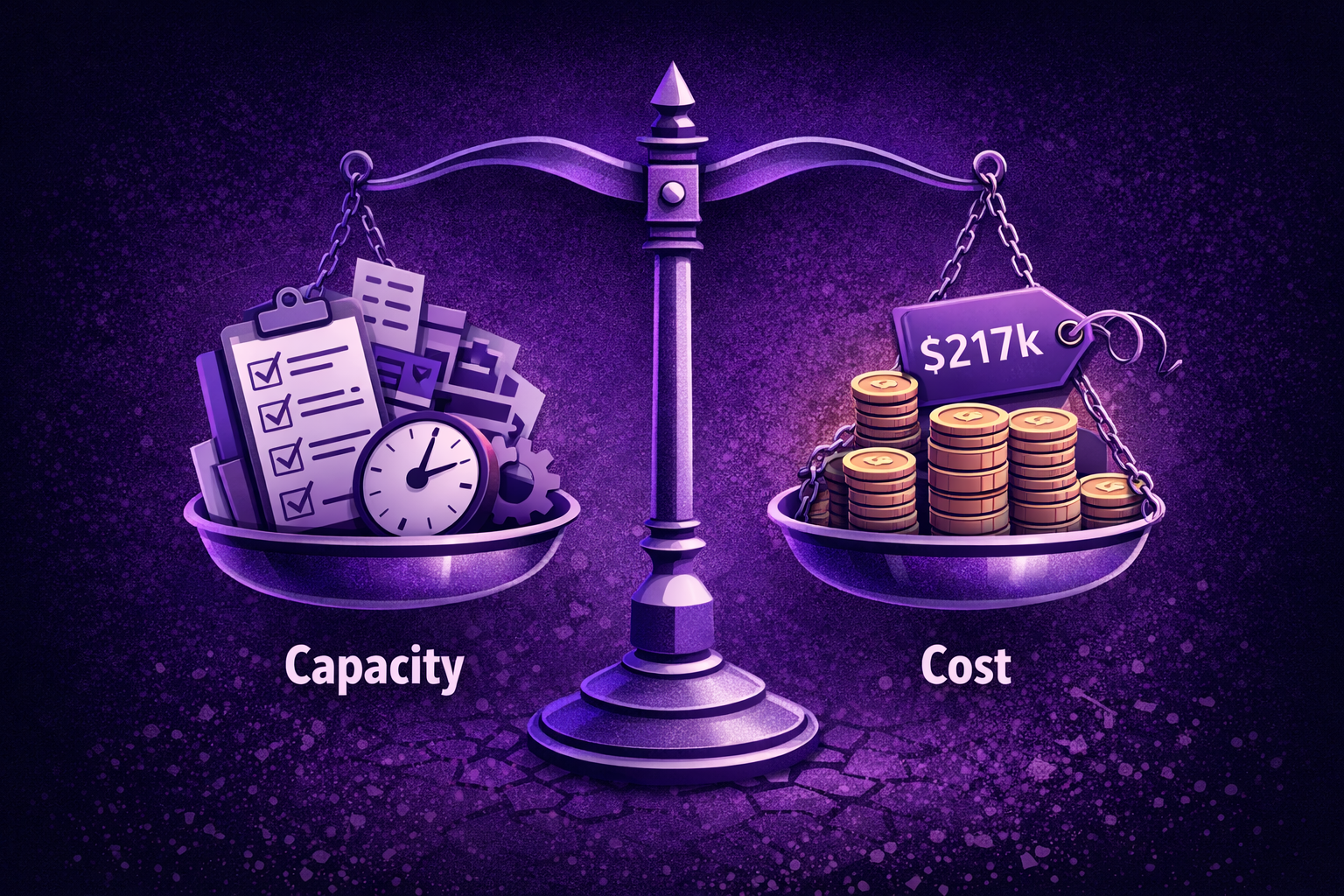
The headcount conversation between engineering and finance fails for the same reason every time, and I've watched it happen at companies of every size. Finance sees headcount as a cost line. Engineering sees it as delivery capacity. Neither side is wrong. But they're speaking different languages, and the translation layer between them, a credible capacity model tied to business outcomes, almost never exists.
Finance asks: "What does this hire cost?" Engineering answers: "$220K fully loaded." That's the wrong conversation. The right conversation is: "What does not making this hire cost?" And the answer to that question is almost always larger, a quarter of delayed revenue, a roadmap that quietly shrinks, a team that burns out and starts losing people you can't replace quickly. But engineering leaders rarely frame it that way, because they don't have the delivery data to make the cost of inaction concrete. They know the team is stretched. They can feel it. They just can't prove it in terms a CFO will act on.
This gap gets worse as you scale. At 5 engineers, the founder knows what everyone is working on and headcount is a gut call. Past 15 to 20, you need a real capacity model, and most teams hit that transition unprepared. The roadmap grows. The headcount request goes in as a number on a spreadsheet. Finance either approves it on trust or pushes back because the justification is thin. Neither outcome is good. Approval on trust means scrutiny later when delivery doesn't match expectations. Deferral means the team absorbs the gap with longer hours and accumulating debt, which shows up six months later as attrition and missed commitments.
The cost of this gap is not abstract. It's the CTO who spends two months in budget negotiations instead of solving technical problems. It's the senior engineer who leaves because the team has been "about to hire" for three quarters. It's the roadmap item that leadership committed to publicly but that the engineering team was never resourced to deliver. I've seen all three happen in the same company, in the same quarter.
The formula itself is simple. The hard part is getting the inputs right.
Start with delivery targets: what does the business need shipped, and by when? Break this down by initiative, not by team. Each initiative has a scope, a timeline, and a skill requirement. Some initiatives need backend engineers. Some need infrastructure. Some need a frontend specialist for two months. The unit of planning is the initiative, not the org chart.
Next, estimate the engineering effort required for each initiative. This is where most headcount plans go wrong, because the estimates are either too optimistic, based on ideal conditions, or too vague, based on t-shirt sizes that don't translate to headcount. The most reliable approach I've seen is to use historical cycle time and throughput data from your own team. If your team ships an average of X story points per engineer per sprint, and the initiative requires Y total points, you can derive the number of engineer-sprints required. This isn't perfect, but it's grounded in your actual delivery data rather than theoretical estimates.
Then account for overhead. Not every hour of engineering time goes to feature delivery. There's on-call rotation, tech debt, code review, mentoring, incident response, and the coordination tax that scales with team size. Clockwise's Engineering Meeting Benchmarks, based on data from over 80,000 Clockwise users in software engineering, found that the average IC engineer gets roughly 20 hours of focus time per week, while engineering managers get about 10. A headcount plan that assumes 40 hours of productive engineering per person per week will under-resource every initiative.
A realistic capacity model looks like this: take your engineers' available hours, subtract meetings, on-call, and maintenance overhead, and what remains is your actual delivery capacity. That number, compared against your delivery targets, is your headcount gap.
Annual headcount plans are useful for budgeting. Quarterly headcount plans are useful for delivery. You need both.
Start with the annual view. Map the full-year roadmap and identify the headcount required to deliver it, broken down by role type and by quarter. Backend, frontend, infrastructure, QA, mobile. This gives finance the budget number they need and gives you a hiring timeline.
Then build the quarterly plan, which is where the real operational detail lives. For each quarter, identify the specific initiatives that are in scope, the engineers assigned to them by name rather than just by count, and the gaps. A gap is any initiative that is committed but doesn't have enough engineering capacity assigned. These gaps are your headcount requests.
The quarterly plan should also include a capacity buffer for unplanned work. Every experienced engineering leader knows that roughly 15 to 25 percent of engineering time will go to work that wasn't on the roadmap at the start of the quarter: production incidents, urgent customer requests, security patches, unexpected tech debt. If your headcount plan doesn't account for this, you'll be over-committed by default.
Structure the plan around four columns for each quarter: committed initiatives with required headcount, current capacity adjusted for overhead, the gap between them, and the proposed action. That action is either hire, bring in a contractor, defer the initiative, or descope it. This makes the tradeoffs visible to everyone in the room.
Engineering leaders often present headcount as a list of roles and salaries. Finance sees cost. What they don't see is the delivery risk of not funding those roles, or the revenue impact of delayed initiatives.
Reframe the conversation. Instead of "we need three senior backend engineers at $180K each," present it as "Initiative X is projected to generate $2M in ARR and requires three senior backend engineers to ship by Q3. Without them, the launch moves to Q1 next year, and we lose two quarters of revenue." That's the same ask with a fundamentally different framing.
Present multiple scenarios. A headcount plan with a single number feels like a demand. A headcount plan with three scenarios feels like a strategy. Show the fully funded scenario where everything on the roadmap gets delivered on time, the partially funded scenario where some initiatives are deferred, and the no-new-headcount scenario showing what happens to the roadmap with the current team. Let leadership choose the risk they want to take.
Use allocation data to show where the current team's time is going. If 30 percent of engineering time is going to maintenance and tech debt, that's not a headcount problem. It's a prioritization conversation. If 90 percent of the team is committed to in-flight initiatives with no capacity for the next quarter's roadmap, that's a headcount conversation. The data makes the distinction clear.
The engineering leader who speaks in delivery outcomes gets funded. The one who speaks in headcount numbers gets questioned. I've seen this play out enough times to know it's not a soft skill. It's the difference between getting what your team needs and spending another quarter stretched too thin.
The most common failure mode is building the plan in isolation. You estimate headcount based on what you think the roadmap requires, without validating the underlying assumptions with delivery data. The roadmap says "build feature X in Q2," but nobody has checked whether the team's current velocity actually supports that timeline, or whether the dependencies from other teams are realistic.
The second failure mode is treating headcount planning as an annual event. Markets shift. Priorities change. Key engineers leave. A headcount plan that was accurate in January may be irrelevant by April. The teams I've seen do this well revisit their capacity model quarterly at minimum, and adjust hiring plans based on actual delivery data rather than the original forecast.
The third failure mode is ignoring the cost of coordination, and this one gets worse as you scale. Adding engineers doesn't linearly increase delivery capacity. Every new engineer adds communication overhead, onboarding time, and integration cost. A team of 10 does not produce twice the output of a team of 5, especially in the first quarter after the new hires join. Your headcount plan should account for ramp time, typically 2 to 4 months before a new hire reaches full productivity, and the coordination tax that comes with larger teams. I've seen teams hire aggressively and actually slow down for a quarter because nobody budgeted for the onboarding load.
Headcount planning is only as good as the delivery data behind it. If you don't know your team's actual throughput, cycle time, and allocation breakdown, your headcount plan is a guess dressed up as a spreadsheet.
This is where most engineering organizations have a gap. They have Jira data showing ticket counts. They have code hosting data showing commits and PRs. They have sprint velocity numbers that fluctuate from week to week. But they don't have a connected view of where engineering time is actually going, what the real delivery throughput is, and where work is stalling in ways that inflate the perceived need for more people.
Sometimes the answer isn't more engineers. It's less coordination overhead. I've seen teams where 30 percent of engineering time was consumed by status meetings, cross-team dependency management, and manual follow-up on stalled work. Reducing that overhead freed up the equivalent of two to three full-time engineers without a single hire.
But that raises a harder question: how do you know whether you need more people or less friction? The data to answer that exists in your stack. Jira has ticket flow. Your code hosting platform has review latency. Slack has the follow-up threads that never resolved. The problem is that nobody is watching these signals as a connected system. Without that connected view, every headcount plan is built on incomplete information. You end up requesting engineers to solve problems that are actually coordination failures, and finance has no way to tell the difference.
DevHawk helps answer that question by monitoring execution signals across your delivery stack in real time. When tickets stall, PRs age, or handoffs break down across time zones, DevHawk surfaces it and triggers follow-up. This gives you two things headcount planning desperately needs: accurate delivery data showing where time is actually spent, and reduced coordination overhead that changes the headcount math.
I've watched teams discover during headcount planning that they didn't need three new engineers. They needed to fix the review bottleneck that was costing every engineer two hours a week. That's a different kind of headcount plan, one that earns more credibility with finance because it's grounded in data rather than assumptions. And it's the kind of insight that only comes from watching the delivery signals your team is already generating.
What is the simplest formula for engineering headcount planning?
Delivery targets divided by actual throughput per engineer, adjusted for overhead. But the real blocker isn't the math. Most teams have never measured the split between feature delivery time and meetings, on-call, tech debt, and coordination. Start there.
How often should you revisit your engineering headcount plan?
Quarterly at minimum. But treat it as a calibration exercise, not a planning exercise. The question is: how far off were our assumptions last quarter, and what does that tell us about the model?
How do you justify engineering headcount to a CFO?
Present three scenarios: fully funded, partially funded, and current-state. Let the CFO choose the risk. The conversation shifts from "can we afford this" to "which outcome do we want."
Related: engineering KPIs, developer productivity metrics, coordination tax in distributed teams, engineering team structure at scale
Sources cited:
