The PM doesn't spend the morning doing reconnaissance. They start the day knowing where friction exists and what needs a decision. Standups become decision forums instead of status updates. Roadmap confidence increases because problems surface earlier. The PM's time shifts from coordination to judgment.
Most product managers leave daily standups still not knowing whether delivery is actually on track. The meeting moves quickly, updates are shared, blockers are mentioned, and everyone appears aligned. Yet once it ends, there is often a lingering uncertainty about what truly changed and what simply sounded reassuring in the moment.
By mid-morning they know what’s stuck. By noon they’ve nudged the right people. By the end of the day some of it moves forward. The next morning the cycle repeats.
This routine was never meant to be the center of project management. The work that actually matters is deciding what to build, arbitrating tradeoffs, and unblocking teams when problems require judgment. Yet in many scaling SaaS and distributed teams, PM time is consumed by operational overhead that exists because coordination systems are reactive.
AI is not replacing project managers. It is replacing the coordination tax that has quietly taken over the role.
Project management emerged because coordination doesn't happen automatically. Someone has to track dependencies, surface blockers, escalate risks, and keep work moving across time zones. In small, co-located teams, this overhead is minimal. As teams scale or distribute, the coordination tax compounds.
For decades, the default response was to hire more PMs. Add process, add structure, add meetings. The PM became the human layer between delivery systems and executive visibility. They synthesized status updates, chased follow-ups, maintained roadmaps, and ensured nothing slipped through the cracks.
This worked, but it didn't scale. Across the teams we work with, from seed-stage startups to Series C SaaS companies, the pattern is identical. As engineering teams grow past 15 people, PM workload shifts from strategic decision-making to operational firefighting. The time spent on "staying on top of things" grows faster than the time spent shaping what gets built.
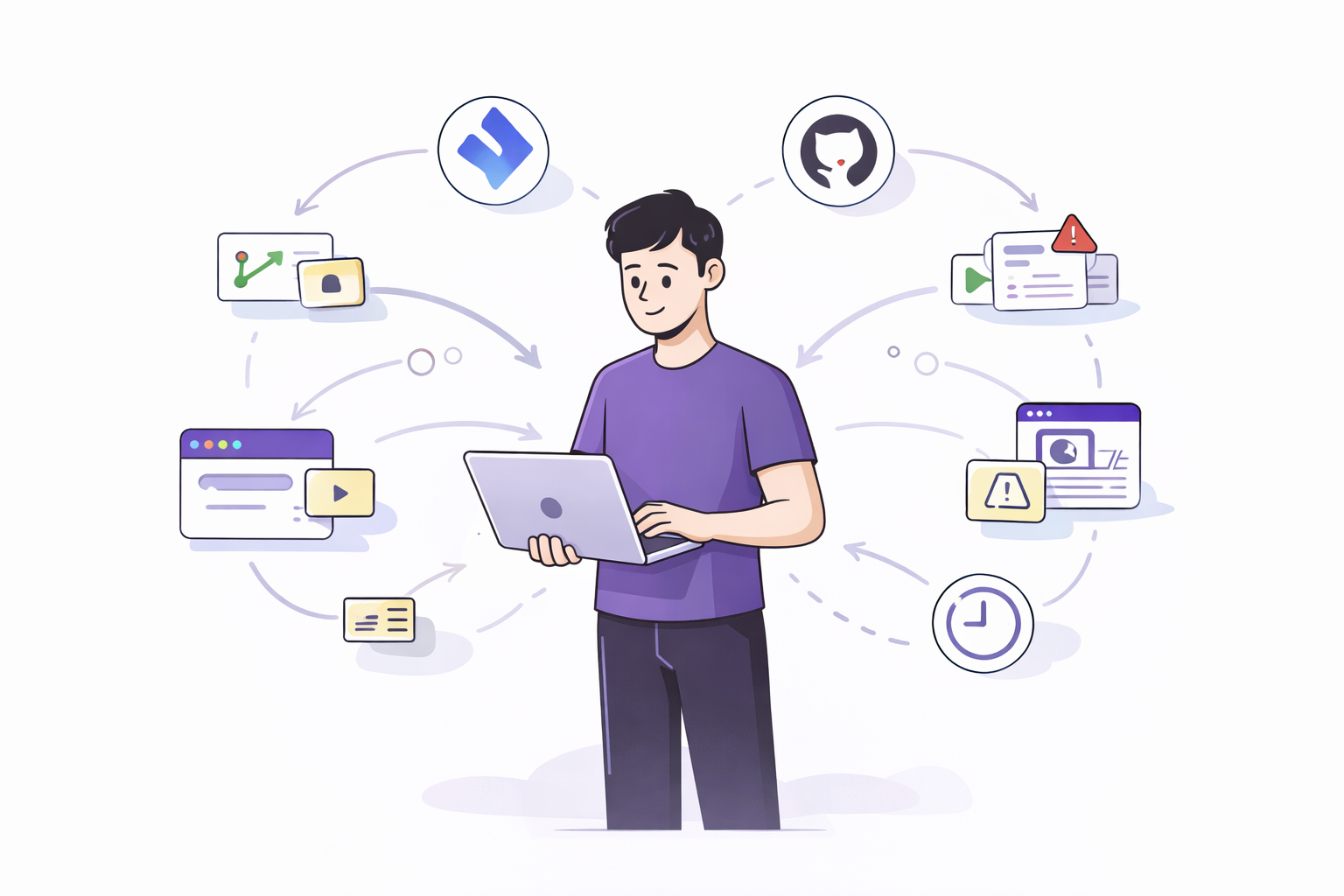
AI is particularly effective in environments where there is abundant signal and repeated patterns. Modern delivery systems generate exactly that kind of environment. Jira reflects when tickets sit in progress without commits, GitHub reveals pull requests aging in review, and Slack often exposes stalled handoffs or unanswered dependencies. Individually, these signals may not appear urgent. Collectively, they form an early-warning system for delivery drift.
When monitored continuously, these signals eliminate much of the manual reconstruction PMs perform each morning. Instead of scanning boards, threads, and review queues to build a mental model of what is happening, the system can surface meaningful deviations from baseline as they occur. The shift is subtle but important: attention is directed toward exceptions rather than routine updates.
Follow-up loops benefit in the same way. In most teams, stalled work does not fail loudly; it lingers quietly. Someone needs to notice the stall, determine who owns it, and initiate a nudge or escalation. AI can formalize this pattern by triggering contextual follow-ups based on predefined thresholds. If a ticket has not moved within its expected cycle time or a PR remains unreviewed beyond normal behavior, the system prompts the appropriate owner. When necessary, it escalates according to clear rules. The PM no longer relies on memory or calendar reminders to enforce accountability.
Status reporting also becomes more grounded in source data. Rather than collecting updates and synthesizing them manually for stakeholders, AI can pull directly from delivery systems to generate summaries of what shipped, what is blocked, and where velocity trends are deviating. The PM’s role shifts from assembling information to interpreting it and guiding decisions.
Where AI stops is equally important. It cannot decide which tradeoff to make when risk surfaces. If a feature is running late, someone must evaluate whether to reduce scope, delay launch, reallocate resources, or absorb the slip. That judgment requires business context, stakeholder alignment, and an understanding of strategic implications that extend beyond delivery metrics.
Most delivery breakdowns are not technical failures but coordination and incentive failures. Misaligned priorities, unclear ownership, and competing objectives require influence and negotiation to resolve. Automation can reinforce accountability, but it cannot replace trust.
The PMs who view AI as leverage understand that reducing coordination tax creates space for higher-value work. The role does not disappear; it becomes more concentrated around judgment, tradeoffs, and direction rather than constant monitoring and follow-up.
The practical question isn’t whether to use AI, but how to integrate it in a way that increases a PM’s leverage rather than just automating the easy parts.
That shift starts by moving from manual monitoring to automated signals. Instead of spending the first hour of the day reading Slack, scanning Jira, and checking PR queues, AI can watch those systems continuously. Define what meaningful drift looks like for your team: tickets sitting in progress longer than normal, PRs aging in review, deployment frequency dropping, or lead times extending. When a threshold is crossed, the PM receives a clear, actionable signal instead of another dashboard to interpret.
Next is moving from reactive follow-up to proactive escalation. Much of a PM’s time goes into chasing updates and resolving silent stalls. AI can trigger nudges automatically based on system state. If a ticket hasn’t moved in 48 hours, notify the owner. If a PR hasn’t been reviewed within the expected window, escalate to the appropriate lead. The PM defines the rules once; the system enforces them consistently.
Reporting changes as well. When leadership asks whether delivery is on track, the answer should not require manual reconstruction. Velocity trends, risk indicators, and bottleneck patterns already exist in the data. AI generates the summary, and the PM adds context and guides the decision.
This doesn’t eliminate project management. It removes the manual overhead that diluted it. When visibility is automated, the PM stops acting as a status aggregator and starts operating as a decision-maker. Meetings shrink because the signals are already there. Reviews become about tradeoffs, not explanations. The work shifts from maintaining motion to shaping it.
This shift will not affect every project management role in the same way.
PMs whose work is centered primarily on information synthesis may feel the pressure first. When the core of the role involves collecting updates, maintaining roadmaps, facilitating standups, and producing status reports, much of that coordination can now be handled faster and more consistently by AI systems. Those responsibilities do not disappear, but they no longer demand the same level of manual effort they once did.
By contrast, PMs whose value lies in judgment under uncertainty are likely to become more important. The ability to arbitrate tradeoffs, navigate ambiguity, build trust across teams, shape strategy, and make decisions when data is incomplete does not lend itself to automation. As coordination overhead decreases, these skills gain leverage. The PM spends less time maintaining visibility and more time applying judgment where it has real impact.
The Standish Group's CHAOS research has tracked software project outcomes for decades. The consistent finding is that project success correlates more strongly with decision quality than with process adherence. Teams with PMs who can make fast, well-informed decisions about scope, timing, and resource allocation outperform teams with more process but slower decision loops.
The question isn't whether AI replaces project managers. The question is whether individual PMs are doing work that's irreplaceable.
After working with teams across early-stage startups, scaling SaaS companies, and first-time software builds, one pattern became clear. Most tools optimize for reporting. Very few optimize for execution.
DevHawk was built for PMs accountable for delivery outcomes. It monitors delivery signals across Jira, GitHub, and Slack. It detects when work stalls, when velocity trends deviate from baseline, when handoffs break down across time zones. It triggers follow-ups to the right people based on context. It escalates when blockers persist.
The PM doesn't spend the morning doing reconnaissance. They start the day knowing where friction exists and what needs a decision. Standups become decision forums instead of status updates. Roadmap confidence increases because problems surface earlier. The PM's time shifts from coordination to judgment.
This isn't about replacing the PM. It's about giving them back the part of the role that matters.
AI won't replace project managers wholesale. But it will replace the version of the role that's primarily overhead.
The PMs who do well will be the ones who stop defending their current workflow and start building systems where coordination happens automatically. The goal isn't more visibility. It's less waiting.
See how DevHawk helps PMs focus on decisions instead of coordination
Which parts of the PM role are most affected by AI right now?
Tasks centered on monitoring, follow-up, and status synthesis are the most exposed. These are rule-based, repeatable, and driven by system signals rather than judgment.
Does reducing coordination overhead mean fewer PMs are needed?
Not necessarily. It often means PM capacity is reallocated. Teams that automate coordination tend to expect PMs to operate at a higher strategic level rather than cover more projects.
How should PMs adapt to stay valuable as AI enters delivery workflows?
By shifting focus from maintaining visibility to making decisions. PMs who define priorities, arbitrate tradeoffs, and guide teams through uncertainty gain leverage as coordination becomes automated.
