Developer productivity isn't a coding problem. It's a coordination problem. This piece breaks down where engineering time actually goes and what a proactive delivery system looks like in practice.
Every engineering leader eventually has the same conversation.
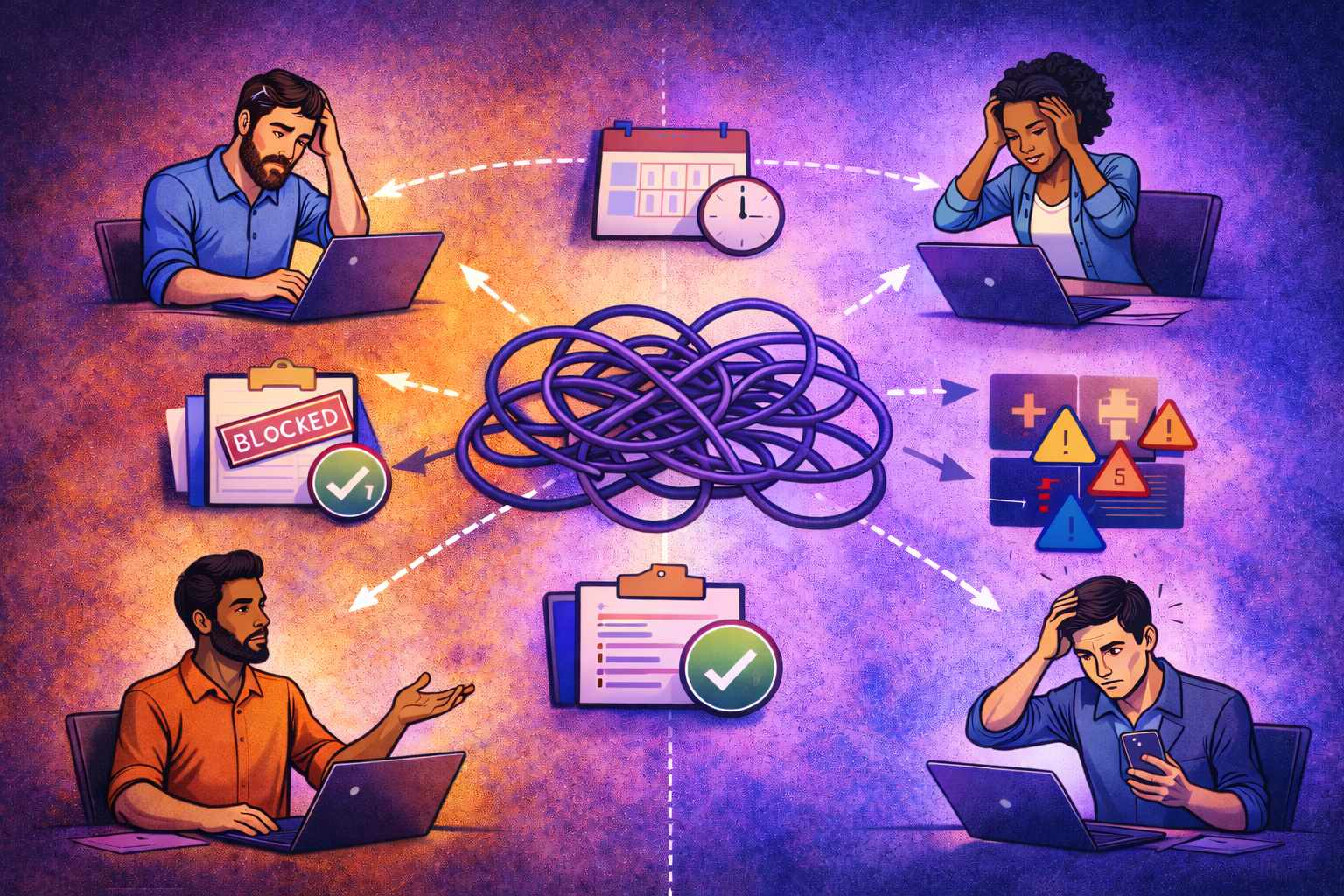
A developer is blocked. The context they need lives in a Slack thread from three days ago, a Jira ticket that hasn't been touched since the sprint started, and a PR that's been sitting in review for four days. Nobody flagged it. Nobody followed up. The work just quietly stopped.
That's not a code quality problem. It's not a tooling problem. It's a coordination problem, and it's the real reason developer productivity is so much harder to fix than people expect.
The current industry obsession with developer productivity tends to start and end in the wrong place. Organizations invest in AI coding assistants, streamline CI/CD pipelines, consolidate tooling. All worthwhile. But a striking finding from Atlassian's 2025 State of Developer Experience report stops most engineering leaders cold: developers spend only 16% of their working time actually writing code. Everything else (context gathering, status chasing, waiting on reviews, navigating blocked handoffs, sitting in synchronization meetings) consumes the rest. That time isn't lost to bad code or poor architecture decisions. It's lost to organizational friction: technical debt, insufficient documentation, slow approval cycles, and the coordination overhead that compounds whenever teams grow beyond a single room.
This is the productivity problem nobody wants to talk about. Not because it's hidden (it surfaces in every engineering retrospective eventually) but because it's uncomfortable. It implies that the bottleneck isn't the developers. It's the systems built around them.
Developer experience (DX) has become a discipline in its own right over the last few years, and for good reason. The research is clear: happier developers ship better software, stay longer, and reduce the compounding cost of turnover in technical teams. But most organizations still approach DX as if it's primarily a technical problem: better tooling, faster pipelines, cleaner CI/CD.
The actual friction points are elsewhere. Ask engineering leaders where time actually goes and the answers are rarely about slow builds or flaky tests. They're about gathering context, waiting on approvals, and maintenance work that nobody planned for. Across teams of different sizes and industries, estimates of unproductive time cluster around 5 to 15 hours per developer per week. Work that could, in principle, be automated, optimized, or eliminated entirely.
That's nearly two full workdays per week, per developer, leaking out through coordination gaps.
The nature of those gaps changes as teams scale and distribute. In a collocated team of eight, a lot of this friction gets absorbed informally. The developer who's blocked wanders over to the person who can unblock them. The PR reviewer gets tapped on the shoulder. The context that lives in someone's head gets transmitted verbally.
Distribute that same team across time zones, add an outsourced component, or scale to 30 engineers and the informal coordination mechanisms stop working. What replaced them in most organizations is more meetings, more status updates, and more manual chasing by project managers and CTOs who end up serving as human routing layers.
There's a specific and thoroughly documented mechanism by which coordination friction destroys developer output. It's not just about time lost to meetings or blocked tickets. It's about what happens to cognitive performance when developers are regularly interrupted or forced to context switch.
Research by cognitive scientist Dr. Gloria Mark has consistently shown that it takes an average of 23 minutes and 15 seconds to fully recover focus after an interruption. For a developer who's been three hours into a complex architectural problem, a "quick question" in Slack doesn't cost five minutes. It costs the morning.
The JetBrains State of Developer Ecosystem 2025, based on responses from over 24,000 developers across 194 countries, identified a revealing pattern by career stage: as developers gain experience and seniority, their challenges shift from technical complexity to coordination responsibilities. The most seasoned engineers, the people whose judgment should be driving technical decisions, end up spending increasing proportions of their time on context switching, status communication, and dependency management. The work that most drains senior engineers isn't the hard engineering. It's the coordination overhead that accumulates around it.
This matters for productivity measurement, but it matters even more for retention and morale. Atlassian's 2025 DevEx survey surfaced a sharp finding: 63% of developers now say their leaders don't understand their pain points, up from 44% the previous year. The growing empathy gap isn't because engineering leaders have stopped caring. It's because the signals they're reading (code volume from AI tools, story points closed, sprint velocity) don't capture where the actual friction lives. Time savings from AI coding tools are being counted as wins while the underlying coordination drag continues to compound.
From a founder’s perspective, the current AI productivity narrative feels incomplete. AI coding assistants have undeniably created real gains. JetBrains reports that 85 percent of developers now use AI tools regularly, and many report saving meaningful hours each week. Studies such as the GitHub Copilot trials across companies including Microsoft and Accenture show measurable output increases, with developers completing more tasks and merging more pull requests. Those gains matter. But they are concentrated in a narrow slice of the workflow: code generation.
In practice, writing code is rarely the true bottleneck inside a growing organization. The friction tends to live elsewhere, in context switching, review cycles, dependency coordination, unclear requirements, and cross functional alignment. In one rigorous real world study, developers using AI tools actually became slower overall despite believing they were faster, largely because time saved in generation was offset by time spent prompting, validating, reviewing, and debugging AI output. Less than half of suggestions were accepted without meaningful edits. From a systems perspective, accelerating one part of the workflow does not automatically accelerate the whole. If AI increases throughput at the individual level but adds cognitive switching or downstream review overhead, the team may feel faster without materially shipping faster. The deeper question is not whether engineers can produce more code per hour, but whether organizations can move from idea to reliable outcome with less coordination drag.
The Stack Overflow 2025 Developer Survey (49,000+ developers globally) captures the ambivalence: 66% of developers report spending extra time fixing imprecise AI suggestions, and 45% call this their top frustration. AI adoption is essentially universal, but positive sentiment about AI tools has dropped from over 70% in 2023 to roughly 60% in 2025.
The broader pattern is instructive for anyone trying to improve developer productivity at a system level. AI tools have reduced friction in code generation. They haven't reduced friction in coordination, dependency management, PR review queues, or the invisible waiting that constitutes most of the developer workday. In many cases, by accelerating code output without accelerating review and integration capacity, they've created new bottlenecks downstream.
Faster code generation that piles up in unreviewed PR queues isn't productivity. It's a different kind of stall.
Most teams are measuring the wrong things. Velocity, story points, and commit frequency are activity metrics. They tell you how busy the team appears. They don't tell you where work is actually stalling.
The signals that predict delivery outcomes are different. They're about latency: how long tickets sit in certain states, how long PRs wait for first review, how often work reopens after completion, how long dependencies go unresolved across team boundaries.
As we broke down in DORA Metrics Explained, the four metrics (deployment frequency, lead time for changes, change failure rate, and mean time to recovery) are research-backed precisely because they measure delivery outcomes rather than activity. Lead time in particular is one of the most revealing because it exposes where work actually gets stuck, not in coding, but in the handoffs between steps: PR wait times, review delays, approval queues. That's the friction this article is about. The SPACE framework goes further by adding the human and process dimensions that pure output metrics miss. The DX framework adds cognitive load and flow state as primary inputs.
What these frameworks share is a recognition that developer productivity isn't primarily about individual output. It's about system throughput: how effectively work flows through the entire development pipeline from specification to deployed feature. Bottlenecks anywhere in that system drag down everyone.
In distributed teams, the latency in that system is especially hard to see. When the review queue is aging, when a dependency has been stuck for two days, when a ticket has been sitting in "In Progress" without a commit in 72 hours, these signals don't surface themselves. Someone has to be watching. And in most teams, the person watching is a PM, an engineering manager, or a CTO who is doing that work manually because no automated mechanism exists to do it for them.
That manual watching is itself a productivity tax. Every hour an engineering leader spends chasing status is an hour not spent on the work that requires their actual judgment.
The teams that manage developer experience and productivity well at scale share a structural pattern. They've moved from reactive oversight (noticing problems when they become visible) to proactive signal monitoring that surfaces risk before it hardens into missed commitments.
This requires three things operating in sequence.
First, clear ownership at the ticket level. Every piece of work has a real owner, and "done" has a shared definition. This sounds obvious. In practice, in distributed teams especially, ownership is often ambiguous. Multiple engineers touching the same ticket, handoffs that happen informally and get lost across time zones, acceptance criteria that nobody challenged during planning. Without clear ownership, any automated system you layer on top will amplify the confusion rather than resolve it.
Second, early signal detection across the delivery pipeline. Not just what's been completed, but what's showing risk signals: tickets in active states with no recent commits, PRs waiting for review beyond a defined threshold, reopened issues clustering around the same areas, dependency gaps that span team boundaries. These signals exist in the data already. Most teams just don't have a systematic way to watch for them.
Third, a structured follow up loop that doesn't depend on a human being in the right place at the right time. In a collocated team, this loop runs informally. In a distributed or outsourced team, it needs to be systematic. Nudges to the right owner when something is drifting, escalation paths that trigger when nudges go unacknowledged, and escalation that happens on the right timeline rather than the next morning after a fourteen hour gap.
Most teams operate with only the third mechanism, and they apply it too late. By the time a CTO is manually escalating a stalled dependency, a day or more has typically already been lost.
DevHawk is built for teams that have accepted the diagnosis but still lack the automation layer to act on it systematically.
It monitors signals across Jira and GitHub (tickets sitting in "In Progress" without commit activity, PRs aging past review thresholds, tickets that have been reopened repeatedly, cross team dependencies that haven't moved) and generates targeted follow up in Slack to the right owner. If work doesn't move after a nudge, it escalates according to rules your team defines.
This isn't project management automation in the traditional sense. It's not generating status reports or building dashboards. It's closing the time between "something is drifting" and "someone has done something about it," which in distributed teams often spans 24 hours or more by default.
For engineering leaders, the specific value is in what doesn't reach their desk. The stalled PR that gets unblocked before it ages to three days. The ticket that's been in "In Progress" for a week without movement that surfaces automatically rather than through a Friday sprint review. The dependency that was blocking two engineers for half a sprint but nobody flagged because the blocker thought someone else was handling it.
There's a constraint worth acknowledging: DevHawk works best when ownership is already clear and done means something. If tickets routinely have multiple assignees, or if the team's definition of "complete" is fuzzy, automated nudges generate noise rather than signal. The tool reinforces a system that already has good structure; it doesn't substitute for that structure.
Developer productivity, properly understood, is not about extracting more output from individual engineers. It's about reducing the friction between having the capacity to build and actually delivering.
Most of that friction is coordination friction. It's the latency between a blocker appearing and someone addressing it. It's the context that exists in someone's head but hasn't been written down. It's the dependency that was assumed to be someone else's responsibility. It's the PR that waited three days for a reviewer who didn't know it was urgent.
The organizations that are ahead on this have stopped treating coordination as an interpersonal problem to be solved through better communication norms or more meetings. They've started treating it as a systems problem, one with observable signals, defined escalation paths, and automated mechanisms for keeping work moving.
That shift is not about adding another AI coding assistant. It is about rethinking where developer time is truly spent and what actually constrains progress. The objective is not to make individual developers move faster, but to design a system that moves faster as a whole.
How can teams tell if coordination, not coding, is slowing them down?
When delivery feels unpredictable and leaders spend time chasing status, unblocking work, or reconstructing context across tools, the bottleneck is usually coordination rather than engineering skill or output.
Why don’t existing processes and dashboards catch these problems earlier?
Because most processes describe how work should flow, and dashboards summarize what already happened. Neither reliably surfaces stalled work at the moment it starts drifting.
What needs to be in place before automation can actually help?
Clear ownership and a shared definition of “done.” Without those, automation creates noise; with them, it reduces waiting, follow-up, and hidden latency.
